
The first ChatGPT App from the Republic of Moldova
Beta · in testing
CONTender — public-procurement integrity, right inside ChatGPT
CONTender brings together Moldova's two official public-procurement sources, MTender and ANSC, in a single conversation. You ask in plain language, and the answer comes back as an interactive widget with the data already combined and computed. 99% of the path is free and anonymous: no account, and it never alters anything at the source.
- 99% free and anonymous
- Read-only, never edits
- Trilingual: RO / RU / EN
- Law-anchored
- One paid tool: $5
- Free for civic use
- 2
- official sources united
- 15
- data tools
- 14
- interactive widgets
- 5
- shortcut commands
One question, both databases
Moldova's public-procurement data lives in two separate systems: the procedure lifecycle in MTender and the appeals in ANSC. To connect a tender with an appeal, you normally open two portals and reconcile two formats by hand. CONTender does it in a single sentence: it queries both sources in the background, combines them, computes, and shows you the result.
CONTender owns no data of its own. It only orchestrates the two official public sources, which means any figure can be checked against the source. It works in Romanian, Russian and English, with Romanian as the default. Legal terms and the reasons behind red flags are anchored in real law articles, loaded at startup and cited structurally; the model invents no legal basis.
It runs inside ChatGPT, on the OpenAI Apps SDK over the MCP protocol. It is not a separate website or a standalone chatbot: it is an app that answers in the conversation and draws interactive widgets.
How it works
CONTender exposes four kinds of capability. Some answer directly; others chain: one tool computes the data, another draws it.
Data tools
Query both sources, combine and compute: tender audit, integrity score, red-flag radar, timelines with legal deadlines. Some render directly, others pair with a display tool.
Display tools
show_audit, show_red_flags, show_buyer_profile, show_supplier_profile, show_document. They receive data from a data tool and draw it in a widget. They compute nothing; they are always the final step in a chain.
Raw (proxy) tools
At startup, CONTender discovers and re-exposes every source tool exactly as it is: 12 from ANSC and 17 from MTender. Direct, granular access to the raw APIs, for very precise questions.
Shortcut commands
Predefined Romanian conversational commands that launch a tool and format the answer cleanly: audit, timeline, integrity, redflags, hearings.
The "decoupled" model separates computation from rendering: a data tool produces the result, and a show_* tool displays it. That is why some actions mean two chained calls, for example audit_tender sending its data to show_audit, which draws it in the procurement-timeline widget.
What it can do
Fifteen data tools, all free in this testing phase. Below, ten of them; the rest are in the full documentation below.
audit_tender Free Full audit of one tender
An end-to-end audit of a tender: the entire OCDS lifecycle plus every associated ANSC appeal, decision and suspension.
integrity_score Free Integrity score, 0 to 100
A composite score from 0 to 100, computed from ANSC signals: appeal rate, court suspensions and annulments, decision severity. A high score means a clean procedure; a low score flags risk (100 = no risk detected). Deterministic, not guessed; MTender data is context and does not enter the score.
red_flag_radar Free Red-flag radar
Scans recent data for anomalies: single-bidder awards, ANSC decisions suspended or annulled in court, ordered by severity.
procurement_timeline Free Timeline with legal deadlines
The unified chronology of the procedure plus the computed legal deadlines: filing window, response window, days remaining and the legal basis.
adversarial_network Free Relationship graph from appeals
Builds a relationship graph from a seed actor: nodes for buyers, suppliers, challengers and panels, edges for appeals. It shows who contested whom.
cpv_heatmap Free Heatmap by CPV category
Samples a year of tenders, extracts the CPV code and value, then aggregates by category: tender count, total value and appeal rate.
compare Free Compare A against B
Compares two tenders side by side (title, authority, value, status, method, appeals and decisions) and highlights differences and suspicious patterns.
buyer_profile Free Contracting authority profile
Aggregates for one contracting authority: number of tenders, total spend and appeals received.
document_intelligence Free Ask questions of an official PDF
Downloads a PDF (an ANSC decision or an MTender tender document) and exposes it as text plus per-page images, for plain-language questions using ChatGPT vision.
prepare_filing_pack Coming soon Pre-filled appeal-pack draft
Will generate a pre-filled appeal-pack draft as a starting point for filing at ANSC: top-5 grounds with strength scores, a procedural calendar, a Romanian draft letter, an evidence checklist, cited precedents and a rough success estimate. (In preparation — see the note below.)
The appeal pack it generates is an informative draft, not legal advice. It is a starting point, to be checked by a lawyer before filing. The tool is still in preparation and not active yet.
Interactive widgets
Answers are not blocks of text but 14 interactive widgets: tender cards, timelines, integrity scores, red-flag radar, hearing agendas, profile dashboards, comparison tables, a document viewer, relationship graphs, CPV heatmaps and an appeal-pack viewer.
Each widget works in three modes: Inline in the conversation, Fullscreen for detail, and Picture-in-Picture so you can keep it in view while the discussion continues.
Who it is for
The same open data, different questions. Five profiles, each with a real prompt to copy and paste into ChatGPT.
The investigative journalist
Follows public money: suspicious contracts, de-facto monopolies, the councils' "house" firms, and ANSC decisions overturned in court.
Needs fast, visual, verifiable evidence without being an OCDS expert. CONTender delivers the signals and profiles in a few sentences, and the civic tier covers the packs for free.
Scan the last 200 tenders and the 2026 ANSC decisions for red flags. Then build me the profile of the supplier that shows up most often in single-bidder awards.
The lawyer / legal counsel
Represents an operator contesting an award, or an authority defending one.
Needs exact deadlines, a correctly cited legal basis and a draft to start from. The timeline tells you how many days you have left; the appeal pack gives you the draft letter.
Build the timeline for procedure ocds-b3wdp1-MD-… and tell me how many days I have left to file an appeal and on which article.
The economic operator
A bidding firm that wants to understand its market position, size up competitors and decide whether a loss is worth contesting.
Vets an authority before bidding and works out whether a case holds up. The golden rule: a low integrity score plus a still-open window means a case worth filing.
What is the integrity score of tender … and am I still within the window to contest? If so, prepare the pack as challenger.
The contracting authority
A procurement officer or internal auditor self-assessing their own procedures.
Wants to anticipate appeals and prepare a defense. The philosophy: run the same analyses a challenger would run, before they do.
Compute the integrity score for OCID and explain each factor that drags it down.
Civil society / the researcher
A monitoring NGO, a researcher or a law student studying systemic patterns rather than isolated cases.
Benefits from the civic tier and from aggregation: correlating spending categories with risk across whole years. The Buy-One-Give-Ten fund covers the packs.
CPV heatmap for 2025 (top 200) and a red-flag radar for the same year — I want to correlate the categories with the risk.
Anchored in law
Deadlines are computed from the available data and the applicable legal regime, and the grounds are cited structurally: label, article, summary, source and in-force date (the articles load at startup). CONTender switches automatically between regimes based on the procedure's date.
Law 20/2026 — on remedies and means of appeal in public procurement (the current regime)
- art. 19 — appeal term: 10 days (electronic means) or 15 days (other means) from becoming aware; no re-filing.
- art. 20 — standstill (await) term: 11 days (electronic) or 16 days; contracts signed earlier are void.
- art. 23 — ANSC solutions: admits the appeal (fully or partially) or rejects it as unfounded, and may order remedial measures.
Law 131/2015 — on public procurement (the old regime, partially repealed from 01.04.2026)
- art. 79–86 — the old appeals procedure, with a 5-day window.
- art. 19 (operator eligibility), art. 25 (interdiction list, 3 years), art. 71 (annulment of the procedure).
The regime rule: procedures started after 01.04.2026 fall under Law 20/2026 (10-day filing, 11-day standstill); earlier ones remain under Law 131/2015 (5 days). The timeline and the appeal pack switch regime automatically.
Price
The reading and investigation path, which is 99% of use, never requires an account or sign-in.
The app is in a testing phase (preview), in Developer mode on ChatGPT. Right now everything is free, including the appeal pack. The $5 price, the civic tier and Buy-One-Give-Ten describe the model planned for after the official launch — they are not active yet.
Free and anonymous
Everything to do with reading, audits, scores, red flags, profiles and timelines is free and anonymous. No account, no sign-in.
The appeal pack — $5 (planned)
After the official launch, the only tool that will cost anything is prepare_filing_pack: $5 one time, roughly 1% of a lawyer's fee, refundable within 7 days. For now, in testing, it is free.
Free for civic use (planned)
In the planned model, registered investigative journalists, NGOs, academics and law students will receive the packs for free, from a shared pool of civic credits.
Buy-One-Give-Ten (planned)
A planned model: every paid pack will add 10× civic credits to the common fund — one purchase "gifts" ten free civic packs.
How to add it to ChatGPT
~3 minutes, no installNo install and no code. It works on free or paid ChatGPT, and once added on desktop it appears on your phone too. At the end, the connection is made with no sign-in (No Auth).
You add it through Developer mode because the app is still in a testing phase (preview) and not yet published in OpenAI's official directory. The steps below are normal for this stage.
https://contender.yoda.digital/mcp -
Open the Apps settings
In ChatGPT (chatgpt.com), click your name/avatar → Settings → in the left menu, Apps (also called "Apps & Connectors").
-
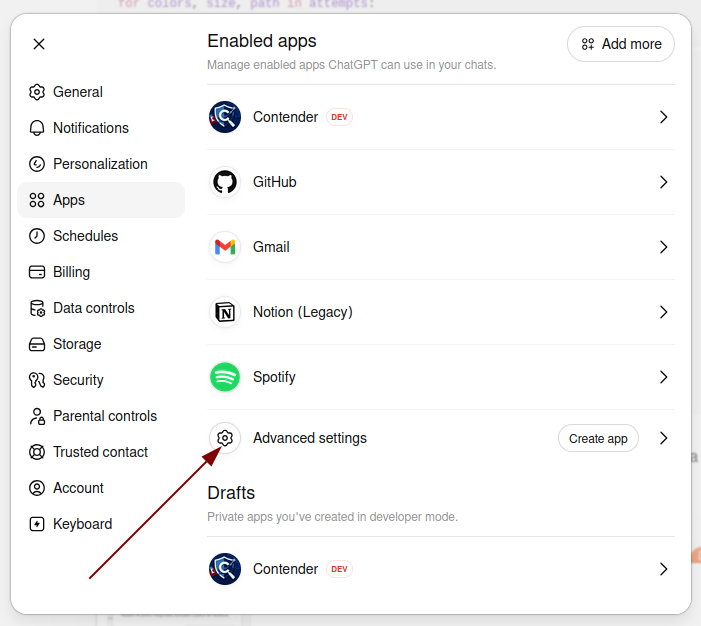
Go to Advanced settings
In the Apps section, scroll down to "Advanced settings" and open it.
-
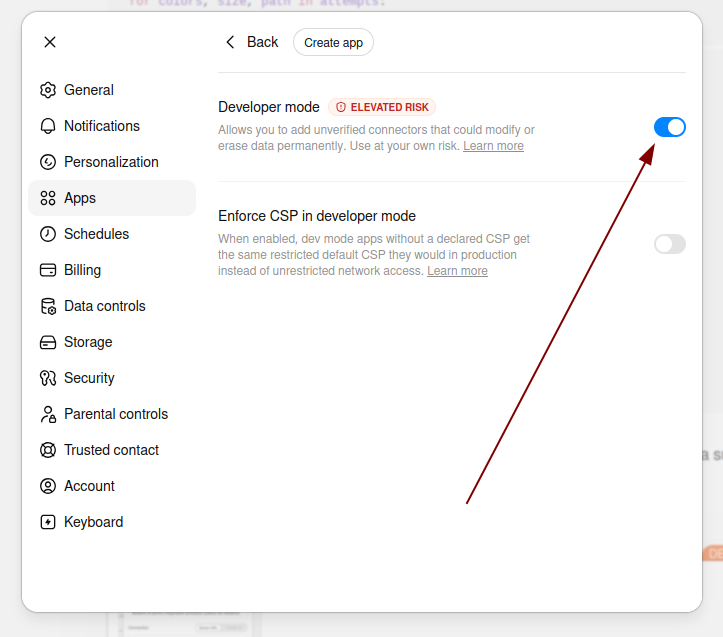
Turn on Developer mode
Switch on "Developer mode" (the toggle turns blue). "ELEVATED RISK" appears — the standard warning for any manually added app. "Enforce CSP" is a separate ChatGPT setting; during testing via Developer mode you leave it OFF, and CONTender ships a strict widget-level CSP anyway.
-
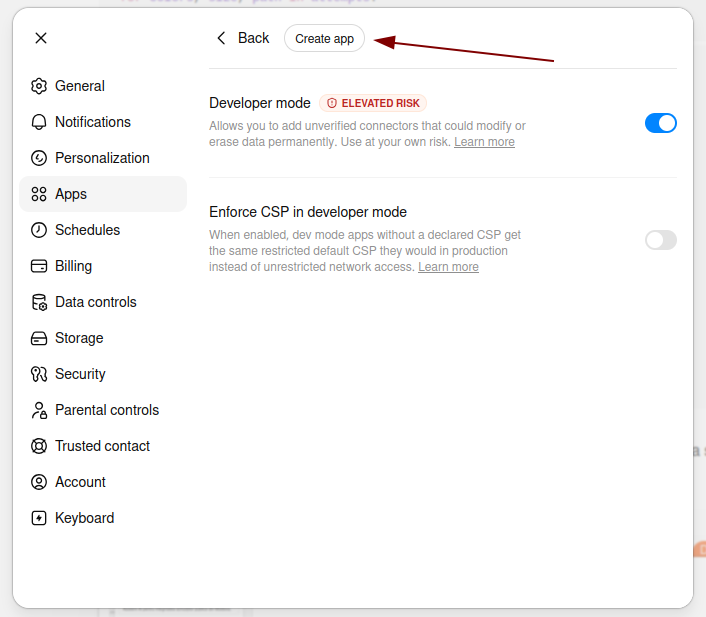
Click Create app
Click "Create app" at the top of the page.
-
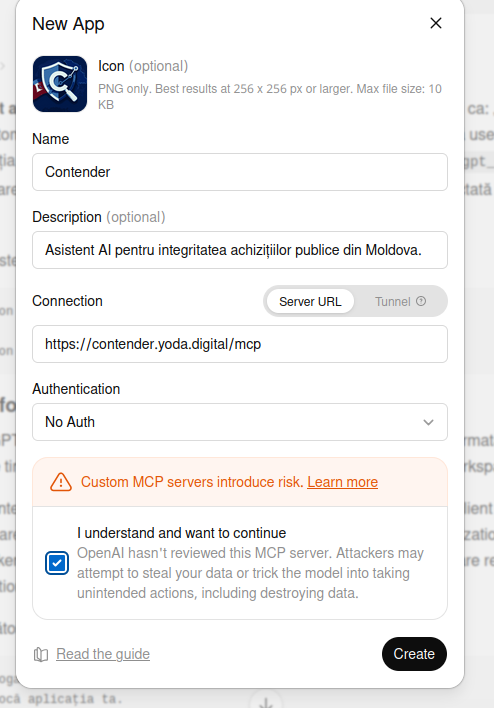
Fill in the New App form
Name = Contender; Description = "Asistent AI pentru integritatea achizițiilor publice din Moldova."; Connection = Server URL; URL = the address above (https://contender.yoda.digital/mcp); Authentication = No Auth; tick "I understand and want to continue" and click Create. Then, in a new chat, "+" → More → Contender and ask a question.
Documentation and guides
Everything you need to understand and use CONTender, as ready-to-download PDFs: the step-by-step setup guide, the full capability documentation, and five real scenarios — one for each profile.
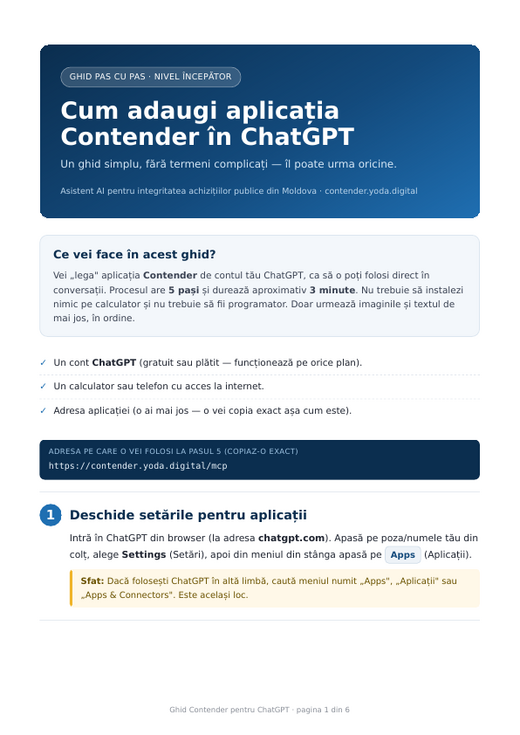 Step-by-step ChatGPT guide How to add the app to ChatGPT in a few minutes, with screenshots. Beginner level, no jargon. Download PDF Guides
 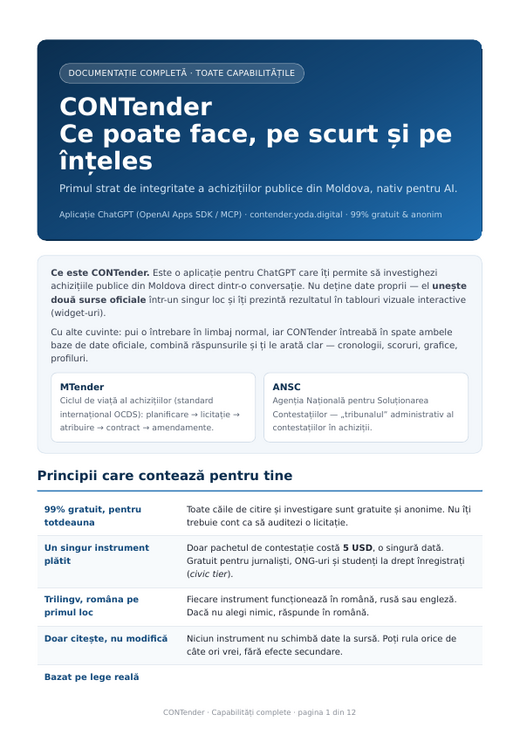 Full capabilities Every tool, widget, prompt and the legal corpus, explained briefly and in plain language. Download PDF Scenarios by profile
  The investigative journalist Red flags, supplier profiles and relationship graphs — visual evidence in seconds. Download PDF Scenarios by profile
  The lawyer / legal counsel Exact deadlines, a correctly cited legal basis, and a draft appeal pack to start from. Download PDF Scenarios by profile
  The economic operator Market position, competitor sizing, and the decision to contest — grounded in data. Download PDF Scenarios by profile
  The contracting authority Proactive self-assessment: run a challenger's analyses before they do. Download PDF Scenarios by profile
  Civil society / the researcher Systemic analysis across whole years, aggregation, and the civic tier for free packs. Download PDF
 Frequently asked questions
Do I have to pay to use it?
Right now, in the testing phase, everything is free — including the appeal pack. The single-paid-tool model ($5), the civic tier and Buy-One-Give-Ten are planned for after the official launch; they are not active yet.
Does the appeal pack replace a lawyer?
No. The pack is an informative draft, a starting point — not legal advice. Always check it with a lawyer before filing it at ANSC. On top of that, the tool is still in preparation during this testing phase.
Is it safe? Why does ChatGPT warn me?
CONTender is read-only: it queries public sources — MTender and ANSC — and changes nothing at the source, so you can run it as many times as you like. The "ELEVATED RISK" warning appears for any app added manually in developer mode; it is not specific to CONTender.
Does it work on a phone?
Yes. Once added on desktop, it appears automatically in the ChatGPT app on your phone. The widgets work inline, in fullscreen and in Picture-in-Picture.
Which languages does it answer in?
Romanian, Russian and English. Every tool works in all three; Romanian is the default if you do not pick another. The draft letter in the appeal pack stays in Romanian regardless of the language chosen.
Does it store my data?
The reading and investigation path is anonymous and requires no account. CONTender owns no data of its own: it only orchestrates the public MTender and ANSC sources. Access credits are held in memory and reset on restart.
How do I know the figures are correct?
The data comes straight from MTender (OCDS 1.1.5) and ANSC, and legal deadlines and grounds are cited structurally, with article and source. The integrity score is deterministic, computed from factors rather than guessed, so it can be checked against the source.
What if I don't see the Create app button?
Make sure you have opened "Advanced settings" in the Apps section and turned on "Developer mode" (the toggle turns blue). "Create app" only appears at the top of the page once developer mode is on.
Can I use my own documents?
Yes. You can upload a PDF straight into ChatGPT, and CONTender analyzes it with the same extraction engine it uses for official documents, exposing it as text and per-page images for plain-language questions.
Who built it
CONTender is the first ChatGPT App from and for the Republic of Moldova, built on the OpenAI Apps SDK over the MCP protocol. It was made by two Moldovan houses with complementary skills: an AI-native engineering studio and a long-standing gov-tech integrator. One side's agent engineering rests on the other's knowledge of how public systems are actually wired.
 Yoda Digital
  esempla systems
 Yoda Digital — an AI-native and web studio in Chișinău, working since 2015, that builds and maintains the infrastructure, architecture and code behind major Moldovan media: TVR Moldova, jurnal.md, jurnaltv.md and unimedia.info. That experience shaped CONTender's guiding principle: deterministic checks are law, AI only assists, and the human decides. It is why the integrity score is computed reproducibly, and why the open-source ansc-mcp-server and mtender-mcp-server keep the data layer auditable, reusable and transparent.
Esempla Systems — a gov-tech company in Chișinău, working since 2009, that builds e-government platforms and data interoperability for the Moldovan state: e-licitatie.md (one of the trading platforms on the MTender system), eApostille, eIntegrity and eGuarantee. That experience in the architecture of procurement systems brings a deep understanding of how the data is structured — which CONTender uses to query and interpret correctly the very same open sources anyone can consult.
Ion Calmîș — CTO at Yoda Digital.
The first ChatGPT App from the Republic of Moldova (to the best of public knowledge at the time of writing): a small team reached a brand-new global distribution surface at the same moment as everyone else and planted civic-tech there.
The data is already open. Ask it questions.
Moldova publishes its procurement through MTender in the OCDS standard and resolves appeals through ANSC, a data foundation unusually open for the region. But open data is worth only as much as the questions you can ask of it. CONTender puts those questions in reach of anyone, in Romanian, Russian or English — no expertise required, and no lawyer needed to begin.
Add CONTender to ChatGPTPrivacy How the score is computed →
See also
AI intelligence for Moldova's public procurement →ansc-mcp-server
Moldova Public ProcurementMCP server exposing Moldova's ANSC public-procurement appeals, decisions, hearings, and PDFs to AI agents.
- Stars
- 0
- Forks
- 0
- Version
- v1.0.3
- License
- MIT
- Tools
- 12
npx -y mcp-ansc-server
→
mtender-mcp-server
Moldova Public ProcurementMCP server for MTender — Moldova's OCDS 1.1.5 public-procurement data, agent-readable.
- Stars
- 0
- Forks
- 0
- Version
- v3.3.0
- License
- ISC
- Tools
- 17
npx -y mtender-mcp-server
→